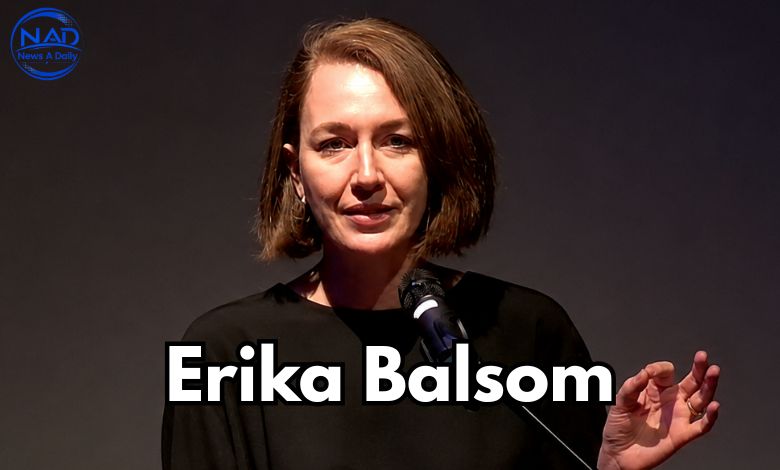
Erika Balsom is a major contemporary scholar whose work has shaped how many readers understand cinema, art, and the movement of images across culture. Her importance comes from the way she studies film not as a fixed or isolated medium, but as a changing set of practices connected to museums, archives, galleries, festivals, streaming platforms, and political life. In a time when moving images appear everywhere, from phones and online platforms to art institutions and restored archives, her writing offers a careful way to think about what cinema is becoming. Erika Balsom combines historical knowledge, theoretical depth, and clear critical writing, making her work useful not only for academics but also for curators, artists, critics, students, and serious viewers. She shows that cinema is never only entertainment or technology. It is also a form of memory, evidence, imagination, and public debate.
Who Is Erika Balsom?
Erika Balsom is a scholar and critic known for her research on film studies, contemporary art, documentary, and artists’ moving image. She is based in London and is associated with King’s College London, where her work focuses on the histories, aesthetics, and politics of nonfiction and experimental cinema. Her writing is influential because it moves across disciplines while remaining precise. She can discuss the museum, the art market, feminist history, documentary ethics, ecological crisis, and media technology without losing sight of individual films and artworks. This balance is one reason Erika Balsom has become such an important figure in contemporary visual culture. She does not treat cinema as something that belongs only to the traditional movie theatre. Instead, she studies how moving images travel, change, and gain new meanings depending on where and how they are shown.
Her Contribution to Film Studies
The contribution of Erika Balsom to film studies is valuable because she expands the field beyond familiar ideas of cinema. Older approaches often focused mainly on theatrical projection, national cinemas, directors, genres, or narrative style. These subjects remain important, but Balsom shows that modern cinema must also be understood through exhibition, circulation, preservation, and institutional context. A moving image work might be projected in a gallery, collected by a museum, screened at a festival, restored by an archive, sold as an edition, or streamed as a digital file. Each setting changes the viewer’s experience and the work’s cultural meaning. Erika Balsom gives readers the language to understand these shifts. Her scholarship reminds us that cinema is not only an image on a screen; it is also a social and material system involving artists, institutions, technologies, audiences, and histories.
Cinema and Contemporary Art
One of Erika Balsom’s most important areas of influence is her study of cinema within contemporary art. Her book Exhibiting Cinema in Contemporary Art examines what happens when film enters galleries and museums. This question matters because the experience of watching changes dramatically depending on the space. A theatre usually asks viewers to sit in darkness from beginning to end, while a gallery often allows people to enter and leave at different moments, move around, or watch several screens at once. Balsom explores how these conditions affect attention, duration, authorship, and meaning. She does not simply celebrate the museum as a new home for cinema. Instead, she asks what is gained and what is lost when moving images become part of exhibition culture. This balanced approach makes her work especially useful for understanding why film and video installations have become so central to contemporary art.
The Importance of Circulation
Another key theme in Erika Balsom’s work is circulation. Her book After Uniqueness: A History of Film and Video Art in Circulation studies how moving image works travel through different formats, markets, institutions, and viewing situations. This is a complex issue because film and video are reproducible media, yet the art world often values rarity, ownership, and limited access. Balsom examines the tension between copying and uniqueness, between public circulation and private collection, and between technological change and cultural value. These questions are deeply relevant in the digital age, when images can move quickly but access can still be controlled by institutions, markets, or platforms. Erika Balsom’s writing shows that circulation is never neutral. The way an image moves affects who can see it, how it is interpreted, and how it survives over time.
Documentary, Politics, and Reality
Erika Balsom has also made significant contributions to thinking about documentary cinema and nonfiction moving images. Documentary is often described as a form that records reality, but Balsom’s approach is more nuanced. She is interested in how nonfiction images create relationships between evidence, ethics, history, and political responsibility. This matters today because visual culture is saturated with images claiming to show truth, from news footage and activist videos to personal recordings and artistic documentaries. Balsom’s work encourages viewers to ask difficult questions: What does an image prove? Who is allowed to speak? How does a film represent suffering, labor, migration, or ecological damage without simplifying it? By asking these questions, she helps deepen the role of documentary criticism.
Feminist Thought and Experimental Practice
A major strength of Erika Balsom’s scholarship is her engagement with feminist thought and experimental practices. Her work helps expand film history by paying attention to artists, methods, and traditions that have often been marginalized. Feminist approaches are important in her writing not only because they recover overlooked figures, but because they challenge the systems that decide which images matter. This includes questions of authorship, labor, institutional recognition, and historical memory. Erika Balsom’s interest in artists’ moving image also shows that experimental cinema is not a minor side category. It is a vital area where filmmakers and artists test new forms of perception, politics, and expression.

Writing Style and Critical Clarity
Erika Balsom is widely valued not only for what she writes about but also for how she writes. Her prose is intellectually serious, but it is also clear and controlled. This matters because writing about film theory and contemporary art can easily become overly abstract. Balsom avoids unnecessary confusion by connecting ideas to specific works, situations, and historical problems. Her writing often moves from close analysis to larger cultural questions, creating a style that feels both rigorous and readable. For students and emerging critics, this is especially important. She demonstrates that strong criticism does not need to be vague or decorative. It should clarify what is at stake and help readers see familiar images in new ways.
Why Erika Balsom Matters Today
The continuing relevance of Erika Balsom comes from the fact that cinema itself is changing. Moving images now exist across many platforms and institutions, and viewers often encounter them in fragmented, mobile, and hybrid forms. Balsom’s work helps explain these changes without falling into simple claims about technology replacing tradition. She shows that every shift in cinema also involves questions of power, access, memory, and value. Her scholarship is important because it keeps history and form at the center of debates about new media. In an age when images circulate faster than ever, Erika Balsom reminds us that speed is not the same as understanding. To understand cinema today, we must ask where images come from, how they move, who controls them, and what kinds of attention they demand.
Conclusion
Erika Balsom has become a defining voice in contemporary film studies because her work captures the complexity of cinema in the modern world. She connects film to art, politics, feminism, documentary practice, institutional history, and digital circulation, making her scholarship essential for anyone interested in moving image culture. Her writing shows that cinema is not disappearing; it is changing location, form, and function. By studying these changes with clarity and depth, Erika Balsom helps readers understand why moving images remain central to contemporary life. Her influence lies in her ability to make cinema feel historically grounded, politically urgent, and aesthetically alive.
(FAQs)
Who is Erika Balsom?
Erika Balsom is a scholar and critic known for her work on film studies, contemporary art, documentary cinema, and artists’ moving image.
What is Erika Balsom best known for?
Erika Balsom is best known for books such as Exhibiting Cinema in Contemporary Art, After Uniqueness, An Oceanic Feeling, and TEN SKIES.
Why is Erika Balsom important in film studies?
Erika Balsom is important because she expands film studies beyond traditional cinema spaces and shows how moving images operate within art institutions, archives, and digital media.
What themes does Erika Balsom write about?
Erika Balsom writes about contemporary art, documentary, experimental film, feminism, circulation, exhibition, ecology, and media history.
Who should read Erika Balsom’s work?
Students, scholars, curators, artists, critics, and serious film viewers can benefit from Erika Balsom’s work, especially those interested in cinema’s changing role